
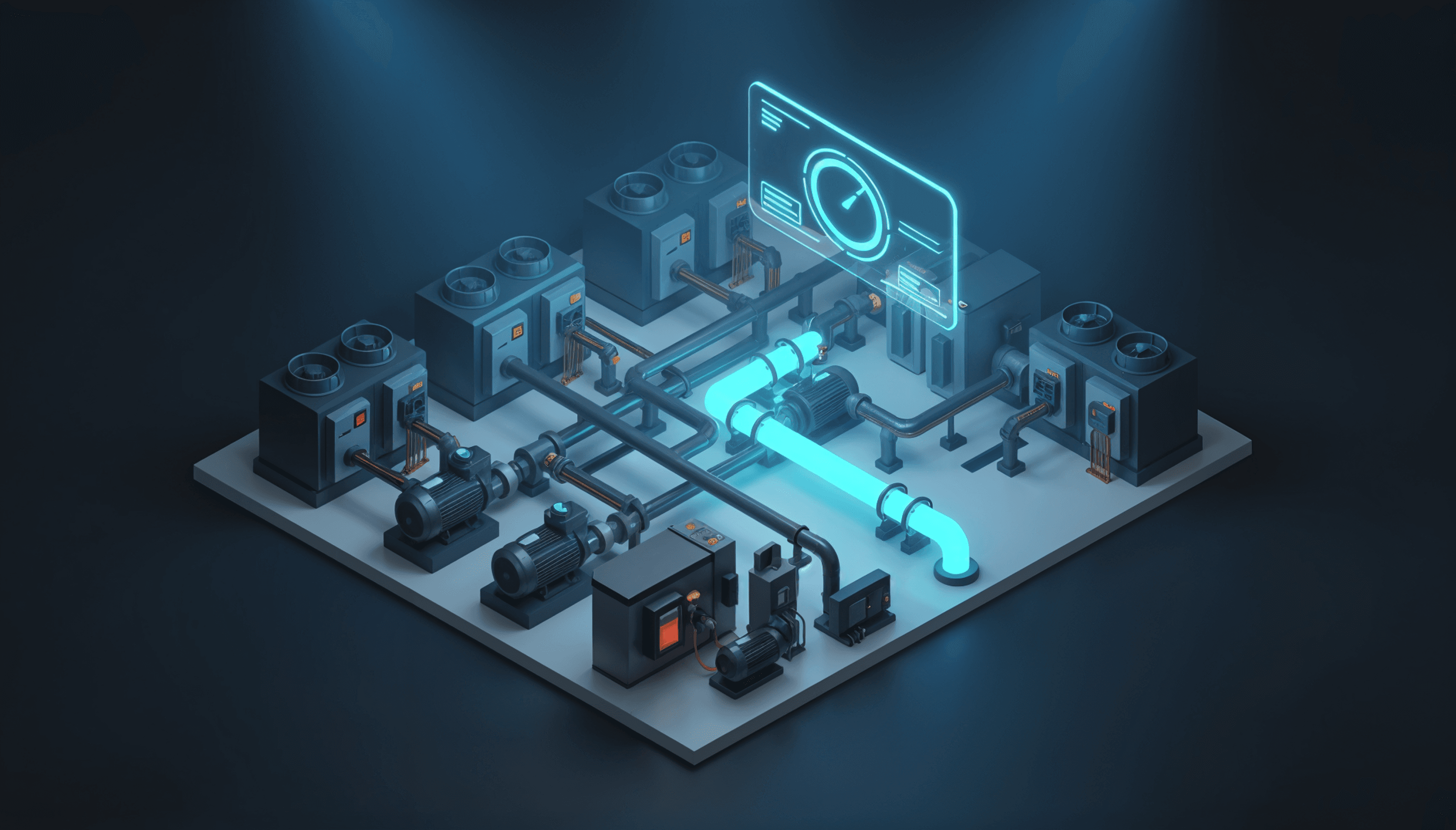
Peak Efficiency Isn't a Given
Most large commercial buildings already operate with capable HVAC systems—efficient chillers, variable-speed drives, and a Building Management System (BMS).
Yet, many of these facilities rarely achieve or sustain their peak efficiency potential.
The issue isn’t always about outdated equipment. It’s how systems are operated, maintained, and adapted to changing conditions over time.
With the chiller plant consuming 35–50% of a building’s total energy, even small inefficiencies compound into significant costs. costs.
True efficiency doesn’t require tearing down what exists; it comes from optimizing, auditing, and intelligently orchestrating what’s already there.
1. Why Chiller Plants Struggle to Stay Efficient
1.1 Equipment Inefficiencies That Build Over Time
Over years of operation, minor degradations—fouled heat exchangers, clogged strainers, degraded cooling tower fills, and drifting sensors—silently erode efficiency. Deferred maintenance and uneven runtime across equipment accelerate this decline.
A chiller that once delivered 0.65 kW/TR at commissioning may quietly slip to 0.75 kW/TR or worse, consuming 10%–15% more energy for the same output. It’s not failure; it’s fatigue, and it goes unnoticed until utility bills start to creep up.
1.2 Fixed Operation in a Variable World
Buildings aren’t static. Occupancy fluctuates, internal loads shift hourly, and weather conditions change daily. Yet, most chiller plants continue to operate on fixed logics and static setpoints. When cooling systems don’t modulate dynamically with demand, they overcool spaces, short-cycle chillers, and waste significant power.
In essence, equipment fatigue + static operation = compounded inefficiency. The twin challenges most facilities battle daily.
2. Audit Before You Act
A performance audit is where efficiency recovery begins. The aim isn’t just to collect data but to reveal the story behind it, identifying where the gaps, drifts, and wastage truly lie.
2.1 What to Measure
Measuring efficiency starts with tracking the right parameters—those directly influencing chiller plant performance.
A robust Building Management System (BMS) helps here, offering visibility into real-time trends across:
- Chiller efficiency (kW/TR) - the most direct measure of performance.
- Chilled & condenser water delta-Ts - to detect flow or heat-exchange imbalances.
- Condenser approach temperature - a marker for fouling or scaling.
- Pump & tower fan speeds (VFD frequency trends) - to assess modulation efficiency.
- Chiller loading patterns - revealing uneven load distribution or over-dependence on a single machine.
- Part-load COP/IPLV trends - for understanding off-design operation.
Purpose-built systems like DeJoule's BMS simplify this process by correlating these micro-parameters into a holistic chiller plant view—helping operators not just see inefficiency but act on it in real time.
2.2 The Data Blind Spot: Missing or Inaccurate Metering
Many facilities still run in a ‘data grey zone.’
Without BTU meters, flow meters, or calibrated energy meters , teams rely on assumptions rather than evidence. Without accurate instrumentation, it’s nearly impossible to quantify actual plant efficiency or validate improvement efforts.
The first step toward transparency is fixing the measurement layer ensuring data fidelity before data-driven optimisation can begin.
3. Institutionalize Discipline: Operations, Maintenance & Accountability
Efficiency isn’t just a function of design—it’s a discipline shaped by how teams operate and maintain their systems daily.
3.1 Operational Best Practices
Keep chillers in their sweet spot (≈60–80% load).
Operate fewer machines at deeper loading to maintain higher efficiency. Avoid short cycling and balance runtime distribution to extend equipment life.
Sequence on real demand, not fixed order.
Prioritize equipment based on current kW/TR performance, not nameplate capacity. Adjust pump and tower operation dynamically to align with real-time load. dynamically to align with real-time load.
Let setpoints float with conditions.
Allow chilled and condenser-water temperatures to vary with weather and building demand, within comfort and humidity guardrails, to reduce lift and save energy.
Rotate assets with purpose.
Follow a run-hour rotation plan supported by condition monitoring or AFDD insights to prevent one machine from bearing the brunt of operations.
These may sound simple, but consistently following them can yield double-digit efficiency gains without new equipment or capital spend.
3.2 Predictive & Preventive Maintenance
- Schedule tube cleaning, cooling tower maintenance, and water treatment rigorously.
- Recalibrate sensors quarterly to avoid drift-driven inefficiencies.
- Deploy Automated Fault Detection & Diagnostics (AFDD) to catch early signs of imbalance, valve leakage, or delta-T shortfall before they affect performance.
Preventive care isn’t just about uptime—it’s about preserving the plant’s designed efficiency curve for as long as possible.
3.3 Strong SLAs and Smarter Accountability
Sustained efficiency demands structured accountability. SLAs with O&M partners should link directly to energy performance indicators (kW/TR) rather than just uptime or reactive maintenance calls.
For facilities seeking deeper assurance, performance-linked service models offer a pragmatic alternative.
Smart Joules' JouleCOOL, for instance, operates on a Cooling-as-a-Service (CaaS) model—where the provider owns efficiency outcomes, guaranteeing performance while clients pay only for the cooling they use. It’s efficiency as a service, not just a promise.
4. Add Intelligence: The Efficiency Multiplier
Even the best-maintained plant reaches a point where manual control or static logic can’t deliver more. That’s where intelligence steps in.
4.1 Coexisting with What You Already Have
DeJoule's Chiller Plant Optimiser (CPO) integrates effortlessly with existing BMS and CPM systems using BACnet protocols. It's not a ‘rip-and-replace’ layer—it’s an intelligence overlay that immediately enhances existing control systems.
4.2 Learning from Day One
From the moment it's deployed, CPO starts learning the building's unique signature—analyzing occupancy patterns, ambient influences, and plant response across varying loads.
Within days, it begins dynamically selecting the right mix of chillers, pumps, and cooling towers while modulating operating parameters—setpoints, frequencies, and staging—every few seconds.
4.3 Achieving True Peak Efficiency
Through dynamic asset selection and continuous real-time modulation, CPO ensures that the chiller plant operates at its optimal efficiency point every minute of operation. It’s not just automation—it’s continuous optimisation that adapts to your building’s heartbeat.
Conclusion: Rediscover, Refine, and Reimagine Efficiency
For existing facilities, achieving peak chiller plant performance isn’t about reinvention—it’s about realignment. Audit what you have. Strengthen operational discipline. Ensure data visibility. And finally, let intelligence transform good performance into great.
The road to high performance doesn’t require new machines—just sharper visibility, disciplined operations, and a system that never stops learning.