
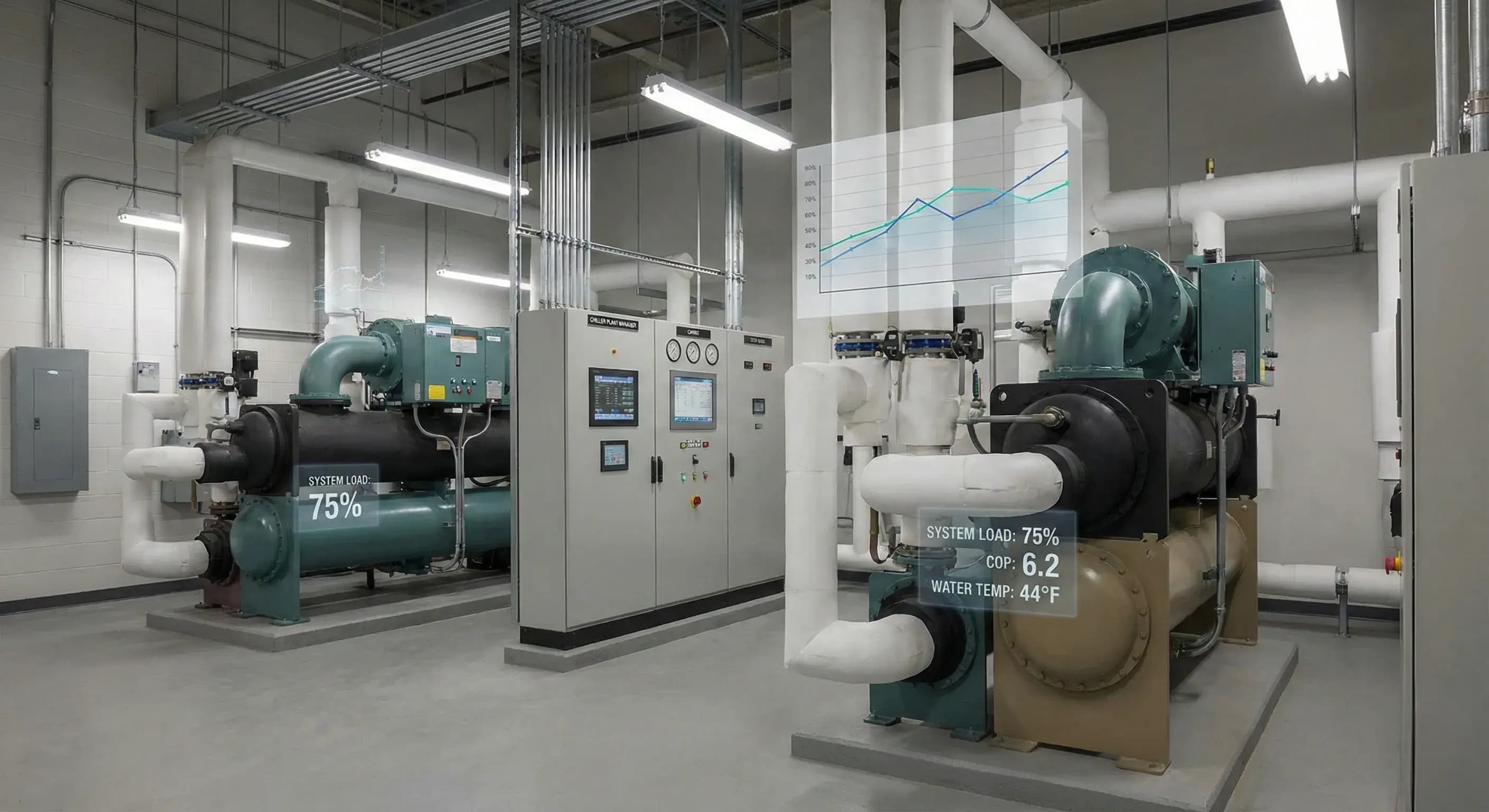
Why CPM-led Optimization Often Plateaus and How DeJoule Breaks the Ceiling
For many Heads of Engineering, installing a Chiller Plant Manager (CPM) feels like a decisive step toward efficiency. Sequencing improves. Operations stabilize. Energy numbers look better than before.
And yet, after a few months, sometimes a year, something becomes evident.
The savings plateau.
Despite a functional CPM, despite competent operators, despite well-maintained equipment, the chiller plant refuses to move closer to its theoretical best. kW/TR fluctuates, often degrades. Overrides creep back in. Conservative operating habits resurface. And the plant settles into a ‘good enough’ equilibrium.
If this sounds familiar, the issue is not your team. And it’s rarely the equipment.
It’s the limits of CPM-led optimization itself.
What a Chiller Plant Manager Does Well and Why That Still Isn’t Enough?
To be clear, CPMs serve an important role in modern chiller plants.
They typically bring:
- Basic chiller sequencing and staging
- Scheduled operations and time-based control
- Thumb rule-based setpoint enforcement
In many buildings, this alone delivers a noticeable step-change from manual operation. Chaos reduces. Predictability improves. Operators gain structure.
But CPMs are, by design, rule-based systems. They execute pre-programmed logic extremely well, but they do not reason about the plant as a continuously evolving system.
And real chiller plants do respond to dynamic conditions in the field, but to a limited extent.
Why CPM-led Savings Plateau in Real Buildings?
Every operating facility experiences constant variability:
- Cooling load fluctuates with occupancy, schedules, and use patterns
- Ambient conditions change every minute, not seasonally
- Equipment ages unevenly, even when installed together
- Heat exchangers foul gradually, not suddenly
- Pumps and towers drift away from their design curves
CPMs struggle here because their optimization logic is fundamentally static.
A few common outcomes emerge:
- Chillers continue to stage correctly, but at sub-optimal part loads
- Pumps and cooling towers operate conservatively to ‘stay safe’
- Setpoints remain fixed because dynamic resets are hard to tune and risk complaints
- Operators intervene because real conditions deviate from designed/prefixed logic
Over time, the plant stops operating at the system optimum and settles for a local one.
The CPM hasn’t failed; it has simply reached the edge of what rule-based control can deliver.
Where DeJoule Enters the Story
DeJoule was designed with this exact problem in mind.
At its core, DeJoule is an intelligence-first building automation platform, built not just to control equipment, but to continuously understand how a building actually behaves under real-world conditions.
Crucially, DeJoule’s Chiller Plant Optimizer has been architected to coexist with existing infrastructure:
- Existing BMS platforms
- Existing CPMs
- Existing chiller plants
There is no rip-and-replace philosophy here.
DeJoule integrates via BACnet or Modbus, sits on top of what is already installed, and begins learning the plant’s behavior from Day 1, without disrupting operations.
This is the foundation on which DeJoule’s Chiller Plant Optimizer (CPO) is built.
DeJoule’s Chiller Plant Optimizer (CPO): A Step Beyond CPMs
It’s important to be precise here. The industry sells CPMs, but the CPO is proprietary to DeJoule. CPO is not another sequencing engine. It is not a more complex rule-set.
CPO is a system-level optimization layer designed to continuously push the chiller plant toward its most efficient operating envelope every minute, not just at commissioning.
And it does this through two core principles.
How CPO Actually Drives Efficiency: DAS and DAM
Dynamic Asset Selection (DAS)
At any given moment, there are multiple ways to meet the same cooling load with the best chiller plant efficiency. CPO continuously evaluates which chillers should run, how many pumps are actually required, and which cooling towers should be active.
This selection is not fixed. It adapts in real time based on:
- Current load
- Wet bulb temperature
- Equipment efficiency characteristics
- Observed system behaviour
The goal is simple: meet demand using the most efficient combination of assets available at that moment.
Dynamic Asset Modulation (DAM)
Once assets are selected, CPO determines how they should operate.
This includes continuous modulation of:
- Chilled water supply temperature
- Condenser water setpoints
- Pump speeds
- Cooling tower fan speeds
This is where CPMs typically stop and where meaningful incremental savings are unlocked.
Why This Matters for Existing Facilities
For operating buildings, the implications are significant.
CPO:
- Does not require replacing the existing CPM
- Does not require new chiller plant hardware
- Does not rely on perfect design conditions
- Improves efficiency continuously, not just once
It addresses the operational reality that buildings drift, loads vary, and assumptions break, and responds accordingly.
Instead of chasing efficiency manually, the plant begins to self-correct.
The Question That Really Matters
Most facilities today already have ‘controls’. The real question is not: “Do we have a Chiller Plant Manager?”
It is: “Is our chiller plant still leaving efficiency on the table despite having one?”
If the answer is even maybe, it’s time to look beyond static optimization.
Ready to See What Your CPM Might Be Missing?
DeJoule’s Chiller Plant Optimizer is designed specifically for operating facilities that want to go beyond rule-based control, without disruption, without replacement, and without guesswork.
If you’re evaluating whether your existing CPM is delivering everything it should, start with a chiller plant performance and readiness review.